
The Essential Guide to Construction Project Bonding for Contractors
Construction project bonding is a critical aspect of the construction industry, especially for California contractors. This comprehensive guide is designed specifically for California contractors, subcontractors, and construction professionals who want to understand every aspect of construction project bonding. Here, you’ll find clear explanations of the main types of bonds (Bid, Performance, Payment, and Maintenance), legal requirements for public and private projects, typical costs, and a step-by-step process to get bonded in California.
Scope:
This guide covers:
The different types of construction bonds (Bid, Performance, Payment, Maintenance, Subdivision, and Supply bonds)
When and why bonds are required for public and private projects
Typical costs and premium ranges for construction bonds
The process for California contractors to secure bonds
Practical tips for increasing your bonding capacity
Frequently asked questions and a summary for quick reference
Why Understanding Construction Project Bonding Matters:
Understanding construction project bonding is crucial for compliance with California and federal regulations, protecting your business and clients from financial loss, and gaining access to lucrative public and private contracts. Bonds provide a financial guarantee that ensures obligations are met on a project and protect project owners, suppliers, and laborers against financial loss. Mastering construction project bonding is essential for business growth, risk management, and unlocking new opportunities in the competitive California construction market.
Most public works in California require bonds under statutes like the California Little Miller Act (Cal. Civ. Code §§ 9550–9566), which mandates payment bonds on publicly funded projects over $25,000. Many larger private projects also require contract bonds to protect lenders and owners.
Budget Bonds helps California contractors secure construction surety bonds, general liability, and workers’ compensation coverage. If you’re planning upcoming bids, request a free quote early in your project planning phase.
How Construction Project Bonding Works
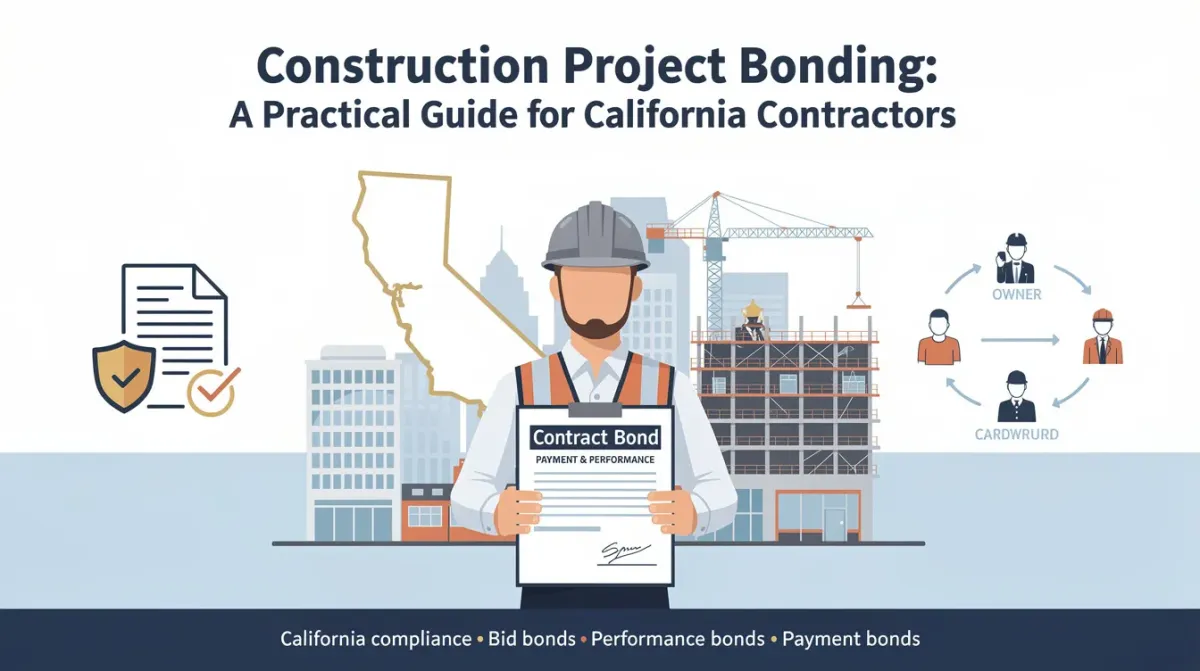
Construction project bonding is a type of surety bond—a three-party agreement between a contractor (principal), project owner (obligee), and surety company—that guarantees project completion according to contract terms. Unlike insurance, the contractor (principal) remains financially responsible to reimburse the surety for any claims paid out.
Key Bond Types
The main types of construction bonds include:
Bid Bonds: Guarantee that the contractor will enter into the contract and provide required bonds if awarded the job.
Performance Bonds: Guarantee that the contractor will complete the project according to contract terms.
Payment Bonds: Guarantee that subcontractors, suppliers, and laborers will be paid.
Maintenance (Warranty) Bonds: Cover defects in workmanship or materials after project completion.
Bonds provide a financial guarantee that ensures obligations are met on a project and protect project owners, suppliers, and laborers against financial loss.
The Three Parties Involved
Every construction project bond involves three parties: the principal (the contractor purchasing the bond), the obligee (the project owner or public agency requiring the bond), and the surety company (the bonding company providing the guarantee). This three-party agreement is fundamental to construction project bonding, ensuring that the project owner is protected if the contractor fails to meet their obligations.
The Bonding Process Lifecycle
Here’s how construction bonds work from start to finish:
Application – The contractor submits financial statements, project history, and work-in-progress schedules to a bond agent.
Underwriting – The surety reviews financials, experience, and current workload to assess risk.
Approval – The surety establishes a bond line with single project and aggregate limits.
Issuance – Specific bonds are issued for individual projects as needed.
Claims – If contractor defaults, obligees can file a bond claim for recovery.
Example: Consider a $1.2 million public school modernization in Los Angeles County. The general contractor must post performance and payment bonds at 100% of the contract value before receiving notice to proceed. If that contractor defaults, the surety pays the owner to remedy the situation—and the contractor must reimburse the surety through an indemnity agreement.
Planning to bid on California projects? Contact Budget Bonds to review upcoming bid calendars and confirm your bonding capacity before submitting proposals.
Now that you understand how bonding works, let's explore why these bonds are essential for California contractors.
Why California Contractors Need Construction Bonds
Access to public work, larger projects, and financial protection are the core reasons California contractors pursue bonding. Bonds signal financial strength to owners and differentiate your construction company from competitors who cannot obtain bonds.
When Bonds Are Mandatory
Construction bonds are typically required on:
Federal projects over $150,000 under the Miller Act
California state and local public works where the Little Miller Act and related codes apply
Private commercial projects financed by banks or institutional investors
Government projects administered by Caltrans, school districts, cities, and counties
Benefits for Contractors
Competitive advantage: Being bondable signals financial stability to project owners
Dispute resolution: Provides a structured process when problems arise
Relationship building: Establishes trust with owners, GCs, and sureties over time
Access to larger projects: Opens doors to multi-million dollar work
Working with Budget Bonds streamlines securing the right bond package alongside general liability and workers’ compensation for full compliance on California job sites.
With a clear understanding of why bonds are needed, let’s look at the specific types of construction project bonds required in California.
Key Types of Construction Project Bonds
Most California projects rely on a core group of types of construction bonds: bid, performance, payment, maintenance, subdivision, and supply bonds.
Public works in California typically require a sequence: a bid bond at the tender stage, followed by performance and payment bonds at contract award. Understanding each bond type helps you prepare for the bidding process and project completion requirements.
Bid Bonds
A bid bond guarantees that if awarded the contract, you’ll enter into the agreement and provide final bond forms. California public entities commonly require bid bonds for 5–10% of the bid amount.
Example: A $900,000 library renovation in San Diego requires a 10% bid bond ($90,000) from each general contractor submitting a proposal. If the winning bidder backs out, the owner claims against the bid bond to cover the cost difference to the next qualified bidder.
Budget Bonds can typically arrange bid bonds quickly for pre-qualified clients, often at minimal premium. These bonds are essential to the bidding process on local governments’ projects.
Performance Bonds
A performance bond ensures that the contractor will fulfill the construction project in accordance with the contract documents, applicable codes, and the agreed schedule. The performance bond guarantees project completion even if the original contractor defaults.
These bonds are commonly issued at 100% of the contract value on California public works and many private projects.
Example: A $4.5 million seismic retrofit of a city hall in Northern California is backed by a 100% performance bond issued in 2025. If the contractor defaults, the surety may:
Finance the original contractor to complete work
Hire a completion contractor
Pay the owner up to the bond amount
Maintaining strong financials and project controls helps you qualify for higher bonding limits—something Budget Bonds can help you plan for.
Payment Bonds
A payment bond guarantees that subcontractors, laborers, and material suppliers will receive payment for their work and materials. This material payment bond protects parties who cannot file a mechanics lien on public projects.
Example: A $2 million community college expansion in Orange County includes a payment bond protecting electrical, HVAC, and concrete subs from non-payment. If the GC doesn’t pay, these parties file claims directly against the payment bond within statutory timeframes.
Budget Bonds can coordinate performance and payment bonds as a package so California contractors only go through underwriting once.
Maintenance & Warranty Bonds
A maintenance bond (sometimes called a warranty bond) covers defects in workmanship or materials discovered after substantial completion, typically for 1–2 years.
California cities and counties often require these for public infrastructure—streets, storm drains, and water lines—accepted into the public system.
Example: A subdivision street improvement in Riverside County requires a 10% maintenance bond for one year after acceptance in 2026. This bond is separate from the performance bond and activates after the project is turned over.
Subdivision Bonds
Subdivision bonds guarantee that developers or contractors will complete required public improvements in new developments: roads, utilities, sidewalks, and streetlights.
California jurisdictions require these bonds before recording final maps or issuing building permits on many residential and commercial tracts.
Example: A 150-lot residential subdivision in Sacramento County requires a $3 million subdivision bond to guarantee completion of off-site improvements. If improvements aren’t completed by agreed deadlines, the city or county claims on the bond to finish the work.
Supply Bonds
A supply bond guarantees that a named supplier will deliver specified materials on time and according to purchase order specifications.
These bonds are often required on large, material-intensive projects—bridges, stadiums, hospitals—where schedule delays create significant costs.
Example: A structural steel supplier issues a supply bond for $750,000 of steel for a 2025 logistics warehouse in the Inland Empire. If delivery fails, the owner or GC can claim against the bond.
Budget Bonds can help both contractors and major material suppliers evaluate when a supply bond is appropriate versus other risk-transfer options.
With a solid grasp of the types of bonds, it’s important to understand how bonds differ from insurance and why both are necessary for California contractors.
Construction Bonds vs. Insurance (General Liability & Workers’ Compensation)
Understanding the difference between construction bonds and insurance is essential for compliance and risk management. Bonds and insurance are complementary but different risk tools. California contractors need both to be fully compliant and protected on most construction contract requirements.
Overview: Bonds vs. Insurance
Construction bonds are a three-party agreement that guarantee performance, payment, and compliance with contractual obligations. If a claim is paid, the contractor must reimburse the surety. Insurance, on the other hand, is a two-party contract that protects the contractor against third-party claims and does not require reimbursement except in cases of fraud.
Surety Bonds
Three-party agreement (principal, obligee, surety)
Protect the obligee; if surety pays a claim, the contractor must reimburse the surety
Guarantee performance, payment, and compliance with contractual obligations
Not “free” coverage—principal bears ultimate financial responsibility
General Liability Insurance
Two-party contract between contractor and insurer
Protects the contractor against third-party bodily injury and property damage claims
Example: A visitor injured on your Los Angeles job site sues for $500,000—your GL policy covers defense and settlement
Insurer does not seek repayment from you (except in fraud cases)
Insurance companies underwrite based on your operations and claim history
Workers’ Compensation Insurance
Required in California when you have employees
Covers medical costs and lost wages for job-related injuries
Essential for contractors on bonded public projects or private projects where owners require proof of coverage
Separate from bonds but often required alongside them in contract specifications
Budget Bonds can package surety bonds with general liability and workers’ compensation policies, simplifying compliance for California contractors tackling complex projects. This coordination ensures all parties involved are protected.
Now that you know the difference between bonds and insurance, let’s look at when construction project bonds are required in California.
When Are Construction Project Bonds Required in California?
Bond requirements depend on project type, contract size, owner specifications, and California statutes. Understanding when you’ll need bonds helps you prepare financially and operationally.
Public Projects
Federal projects:
Miller Act requires performance and payment bonds on construction contracts over $150,000
California state and local projects:
Little Miller Act (Cal. Civ. Code §§ 9550–9566) requires payment bonds for public works over $25,000
State Contract Act often requires performance bonds at 100% or 50% of contract price
Local governments may impose additional requirements
Examples:
A 2026 Caltrans bridge repair in the Bay Area requiring 100% performance and payment bonds for a $12 million contract
A $600,000 city park improvement in Fresno requiring a payment bond under California law
Private Projects
Lenders and institutional investors on multi-million dollar commercial, industrial, and multifamily projects often require bonds to protect their capital
On smaller construction projects, bonds may be optional but differentiate a contractor and reassure sophisticated owners
Banks financing larger projects may require bonds before releasing construction draws
Contractors should talk with Budget Bonds early—before bidding—to confirm which bonds, limits, and bond forms will be needed for specific California agencies or private owners.
With requirements in mind, let’s walk through how California contractors can get bonded.
How California Contractors Get Bonded
Securing bonds is achievable with preparation, especially when supported by a specialist like Budget Bonds. Here’s what the process looks like.
Basic Steps to Obtain Bonds
Initial consultation with a surety-focused agency
Submit documentation:
Financial statements (business and sometimes personal)
Project history and references
Work-in-progress (WIP) schedule
Personal credit information if required
Underwriting review by the surety company
Approval of a bond line establishing single and aggregate limits
Issuance of specific bonds for individual projects
What Sureties Look For: The “3 Cs”
Most surety companies evaluate these factors carefully. Weak business financials or poor personal credit matter significantly in underwriting decisions.
Growth Example
A small contractor in San Bernardino started with a $250,000 single bond limit in 2024. By improving financials, completing projects on time, and building a claims-free track record, they qualified for a $1 million limit by 2026. This progression opened doors to larger projects and higher bonding limits.
Ready to get started? Submit your latest financials and project pipeline to Budget Bonds for a free bonding review and quote tailored to California requirements.

Now that you know how to get bonded, let’s review what construction project bonds cost and how to plan for these expenses.
What Construction Project Bonds Cost
Construction bond costs are typically a percentage of the bond amount, varying based on financial strength, project size, and risk profile.
Typical Premium Ranges
Real Dollar Examples
$1 million performance and payment bond package on a school project in 2025: a well-qualified contractor might pay $10,000–$25,000 in total bond premium
$250,000 performance bond for a small municipal job: a newer contractor could pay $3,000–$7,500
Bid bonds: Often issued at flat or minimal charge when part of an ongoing relationship
Maintenance bonds: Typically 0.5–2% of the bond amount
Retention Bond Considerations
A retention bond can replace cash retention held by owners, freeing up your working capital. Premium costs vary but can improve your cash flow on completed projects.
Contractors should factor bond premiums into their bids. Budget Bonds can help estimate premiums accurately before submitting California public or private tenders, ensuring your construction bond costs don’t eat into project margins.
With costs in mind, let’s discuss how you can increase your bonding capacity to take on larger projects.
Tips to Increase Your Bonding Capacity in California
Higher bonding capacity allows contractors to pursue larger, more profitable projects and handle multiple jobs simultaneously. Here’s how to grow your limits.
Understanding Bond Lines
Your surety establishes limits:
Single limit – Maximum bond amount for any one project
Aggregate limit – Total bonded backlog allowed at any time
Example: A $750,000 single limit and $2 million aggregate limit allows several concurrent projects as long as total bonded work stays under $2 million.
Practical Strategies for Growth
Maintain clean, CPA-prepared financial statements – Ideally on a calendar-year basis with timely year-end reports
Preserve strong cash flow and working capital – Avoid excessive short-term debt that signals financial instability
Complete projects on time and on budget – Minimizing change order disputes and claims builds your track record
Start with smaller bonded projects – Build experience before jumping into multi-million dollar work
Address personal credit issues – Personal credit matter for principals and indemnitors
Avoid overextending – Sureties watch WIP/backlog ratios carefully (under 10:1 is ideal)
Budget Bonds can review your financials and current workload to recommend concrete steps to expand bond lines over a 12–24 month period.
With your bonding capacity on the rise, here’s how Budget Bonds can support your business every step of the way.
How Budget Bonds Supports California Contractors
Budget Bonds focuses on helping California contractors secure bonds, general liability, and workers’ compensation so they can qualify for and safely execute more projects—from overseas projects to local public works.
Services Offered
Surety bond placement:
Bid bonds
Performance and payment bonds
Maintenance and warranty bonds
Subdivision bonds
Supply bonds
Contractor license bond ($25,000 CSLB requirement)
Mechanics lien bond support
Insurance solutions:
General liability insurance tailored to contracting trades
Workers’ compensation programs meeting California legal requirements
Who We Work With
New contractors trying to qualify for their first bonded public job
Established firms looking to grow bonding capacity into the multi-million dollar range
Specialty contractors and suppliers seeking project-specific bond solutions
Construction industry professionals across California from San Diego to Sacramento
A construction bond assures project owners and stakeholders that your company can deliver. Construction bonds cover the financial risks that keep owners up at night, and providing surety bonds positions you as a reliable partner.
Construction bonds function as both a compliance requirement and a competitive advantage. When public entities require contract bonds, being pre-qualified means faster project success and more wins.

Get Started Today
Request a free quote or bonding review from Budget Bonds. Having your bonds, general liability, and workers’ compensation coordinated through one California-focused partner simplifies compliance and saves time on every bid.
Whether you’re pursuing your first bonded job or expanding into larger projects, Budget Bonds provides the expertise California contractors need. Contact us today to discuss your bonding needs and take the next step in growing your contracting business.
Construction Project Bonding FAQ & Summary
What is construction project bonding?
Construction project bonding is a type of surety bond—a three-party agreement between a contractor, project owner, and surety company—that guarantees project completion according to contract terms. It provides a financial guarantee that the contractor will fulfill their obligations, and if not, the surety steps in to protect the project owner and other stakeholders.
What types of bonds are required for California projects?
The main types of construction bonds required for California projects include:
Most federal and public works projects exceeding $100,000–$150,000 legally require bonding. Private projects may not require bonds by law, but many private owners request them for additional security.
Why are bonds important for public and private construction?
Bonds protect project owners, suppliers, and laborers against financial loss by providing a financial guarantee that obligations will be met. They are required on most public projects to protect taxpayer money and ensure contractors fulfill their obligations. On private projects, bonds offer additional security and peace of mind to owners and lenders.
Fact References:
Construction project bonding is a type of surety bond, a three-party agreement between a contractor, project owner, and surety company that guarantees project completion according to contract terms.
The main types of construction bonds include Bid, Performance, Payment, and Maintenance bonds.
Construction bonds protect project owners, suppliers, and laborers against financial loss.
Bonds provide a financial guarantee that ensures obligations are met on a project.
Construction bonds are often required for projects involving significant financial risk, while insurance is more general in nature.
Most federal and public works projects exceeding $100,000–$150,000 legally require bonding to ensure taxpayer money is not wasted on incomplete projects.
Surety bonds are mandatory for most government and public projects under the Miller Act.
The Miller Act mandates performance and payment bonds for any federal construction contract exceeding $150,000.
Most states have enacted their own versions of the Miller Act, known as Little Miller Acts, which require similar bonding for state and local government projects.
Bonds are typically required on public projects to protect taxpayer money and ensure contractors fulfill their obligations.
Private projects may not require bonds by law, but many private owners request them for additional security.