
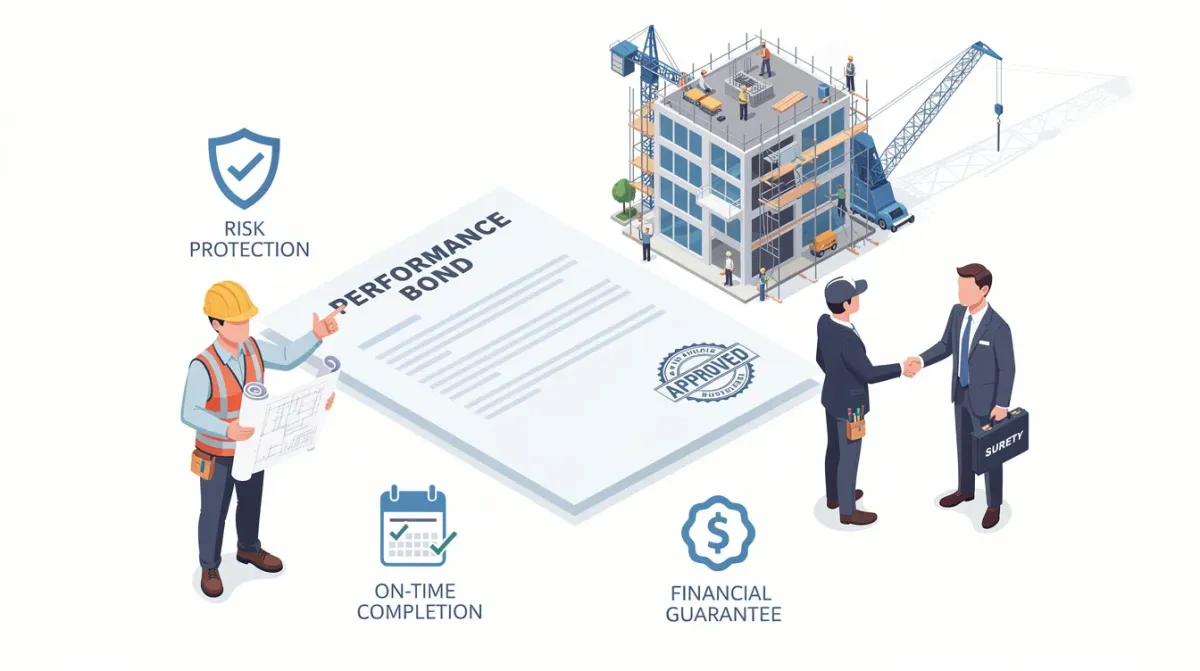
Understanding Performance Bond in Construction: A Comprehensive Guide
A performance bond in construction is one of the most critical financial instruments protecting project owners from contractor failure. Whether you’re bidding on a federal highway project or developing a private commercial building, understanding how performance bonds work can mean the difference between a successful project and costly delays.
This guide breaks down everything you need to know about construction performance bonds—from basic mechanics to practical tips for both owners and contractors navigating these surety bonds in 2026 and beyond.
What is a Performance Bond in Construction?
A construction performance bond is a three-party surety bond that provides a financial guarantee that a contractor will complete a project according to the construction contract. Think of it as a promise backed by a third party: if the contractor fails to deliver, someone else steps in to make things right.
The three parties involved in every performance bond are:
Project Owner (Obligee): The party that requires the bond and benefits from its protection
Contractor (Principal): The party performing the work and obtaining the bond
Surety Company: The entity that underwrites the bond and guarantees contractor performance
When a contractor defaults—whether through insolvency, abandonment, or failure to meet contractual obligations—the surety is obligated to remedy the situation. This might mean financing the original contractor to complete the work, hiring a new contractor, or compensating the property owner for losses up to the bond limit.
On public projects, the amount of the bond typically equals 100% of the contract price. Private construction projects usually require bonds at 10%–50% of the total contract value, depending on jurisdiction and risk profile.
Real-World Example: A 2024 mid-rise office development in Chicago required a $15 million construction contract with a 100% performance bond from an AM Best A-rated surety. This gave the lender confidence to release financing despite volatile material costs and market uncertainty.

How Performance Bonds Work on Construction Projects
The bonding process begins after a project owner awards a construction contract. The performance bond becomes a condition to issue the notice to proceed—no bond, no mobilization.
Here’s the typical lifecycle:
Step 1: Contract Award The owner selects a contractor, often after evaluating bid bonds submitted during tender. The contract specifies bond requirements, including the bond amount and acceptable surety qualifications.
Step 2: Bond Issuance The contractor works with a surety company to obtain the performance bond. The surety conducts underwriting, reviewing the contractor’s financial information, work history, and capacity. Once approved, the bond is generally issued before mobilization begins.
Step 3: Project Execution During construction, the surety may monitor contractor performance through periodic reports. The bond remains in force until project completion and often through warranty periods.
Step 4: Claim (If Needed) If the contractor defaults, the project owner files a performance bond claim. The surety investigates and selects a remedy—from financing completion to paying damages equal to the bond amount.
A critical distinction: surety bonds differ from traditional insurance. The principal must indemnify the surety for any amounts paid out. This means contractors remain financially liable even after the surety pays a claim.
Key Parties in a Construction Performance Bond
Understanding each party’s role clarifies how performance bonds ensure project completion:
Owner (Obligee): Can be a public authority like a state DOT, municipality, private developer, or institutional owner such as a university. The obligee sets bond requirements and benefits from protection against contractor default.
Contractor (Principal): The general or prime contractor awarded the main construction contract. On higher-risk projects, large subcontract packages (steel, mechanical, electrical) may also require performance bonds.
Surety: A specialist surety company, often part of a major insurer or bank-backed facility. The surety evaluates the contractor’s financials, history, and work program before issuing bonds. Surety bond companies typically require a general indemnity agreement where the contractor—and often its owners personally—guarantee repayment if a claim is paid.
Step-by-Step: What Happens When a Contractor Defaults
Consider this scenario: A general contractor working on a 20-month public works project in 2026 becomes insolvent at the 50% completion mark. The project sits with incomplete structures, mounting schedule risk, and unpaid subcontractors.
Phase 1: Default Declaration The project owner must formally declare default under the construction contract. This involves documenting the contractor’s failures and providing written notice to the surety per bond contract requirements. The defaulting contractor receives notice as well.
Phase 2: Surety Investigation The surety company investigates the claim. They review project documentation—progress reports, change orders, RFIs, schedules, and payment records. This phase determines whether the default is valid under bond terms and identifies the best remedy.
Phase 3: Remedy Selection The surety has several options:
Finance the existing contractor to complete the work
Arrange for a replacement contractor to take over
Tender remaining work to qualified contractors through competitive bidding
Pay the owner up to the bond limit as financial compensation
Phase 4: Resolution The surety executes the chosen remedy. Their liability is capped at the penal sum of the bond—any additional costs above that amount fall to the owner unless negotiated otherwise.
Throughout this process, accurate project records prove essential. Disputes often arise over whether a contractor is actually in default, making documentation critical for all parties.
Legal and Regulatory Framework for Construction Performance Bonds
Performance bonds in construction operate within a well-established legal framework. Government projects almost universally require them, while private developments often mandate bonds to satisfy lender requirements.
The Miller Act, enacted in 1935 and still governing federal government construction contracts, requires performance and payment bonds on federal construction projects exceeding $150,000. The law emerged to protect taxpayers from contractor failures that could leave projects incomplete and public funds wasted.
State “Little Miller Acts” impose similar requirements on state and municipal projects. Nearly every state has adopted some version of these statutes for public projects.
Internationally, countries including the UK, Canada, Australia, and EU member states use performance bonds in public infrastructure contracts under their own procurement frameworks. Standard contract forms like FIDIC, JCT, and AIA documents reference bond requirements and outline claim procedures.
Owner Requirements and Tender Conditions
Project owners establish bond requirements in bid documents. Typical specifications include:
Minimum bond amount (often 100% of contract value)
Acceptable surety rating (e.g., AM Best A- or better)
Specific bond forms or approved equivalents
Submission deadlines relative to contract award
Performance bonds interact with bid bonds during procurement. Bidders submit bid bonds (typically 5%–10% of bid amount) during tender. Upon contract award, the winning contractor furnishes performance and payment bonds before work begins.
For private construction—such as a 2025 high-rise residential tower—developers and lenders frequently require performance bonds as financing conditions. This reduces completion risk and protects the financial institution’s investment.
Benefits and Drawbacks of Performance Bonds in Construction
For Owners
Benefits:
Assurance of project completion even if the contractor fails
Reduced counterparty risk through surety prequalification
Improved access to financing for the project
Structured process for handling contractor default
Drawbacks:
Bond premiums increase overall project costs
Claim processes can be time-consuming and contentious
Must accurately estimate potential nonperformance costs when setting bond amounts
For Contractors
Benefits:
Enhanced credibility with public and private owners
Ability to bid on larger construction projects
Validation of financial strength through surety prequalification
Drawbacks:
Premium costs reduce profit margins
Bonding capacity can constrain growth across multiple concurrent projects
Strong financial documentation requirements demand ongoing administrative effort
Performance Bonds vs. Payment Bonds in Construction
While performance bonds protect the project owner’s interest in completion and quality, payment bonds serve a different purpose: protecting subcontractors, laborers, and material suppliers against non-payment.
On a typical public school or hospital build, both performance and payment bonds are issued together—often for 100% of the contract amount. This combined package addresses two distinct risks.
Payment bond claims arise when subcontractors or suppliers submit invoices that go unpaid. Performance bond claims arise from failures to perform contract requirements—missed schedules, defective workmanship, or project abandonment.
Most public projects require performance bonds alongside payment bonds as standard practice. The Miller Act mandates both for federal government contracts, recognizing that a project isn’t truly secure unless workers get paid and work gets completed.
Cost of a Construction Performance Bond
The performance bond cost typically ranges from 1% to 4% of the contract price. The exact premium depends on project size, duration, complexity, and contractor strength.
Large, well-capitalized contractors with strong financial statements and good track records may secure rates closer to 0.5%–1.5%. Smaller contractors or those with weaker credit histories often pay rates at the higher end of the range.
Worked Example: A $5 million contract in 2026 with a 2% premium results in a $100,000 bond cost. While the contractor pays this premium, it’s typically factored into the contract price—meaning the cost ultimately flows into the owner’s project budget.
Additional factors affecting cost include:
Contract type (design-bid-build vs. design-build)
Project complexity (hospitals vs. warehouses)
Geographic location and local market conditions
Contractor credit history and clean license history
How Bonding Capacity and Credit Affect Pricing
Bonding capacity represents the maximum aggregate amount of work a surety will support for a contractor at any given time. This capacity depends on net worth, working capital, and historical performance.
Contractors with strong balance sheets, consistent profitability, and minimal claim histories secure better rates and higher limits. Key underwriting metrics include:
Working capital ratio (ideally 10%–15% of bonded backlog)
Net worth relative to single project size
Backlog-to-equity ratios
Profitability trends and cash flow stability
For contractors with weaker credit or limited track records, sureties may restrict capacity, require additional collateral, or decline to issue bonds on complex commodity contracts or construction projects.
How Contractors Obtain a Performance Bond for Construction
Step 1: Contact a specialist surety broker who understands construction. They’ll guide you through the bonding process and connect you with appropriate surety bond companies.
Step 2: Prepare your underwriting submission. Core documentation includes:
Audited or reviewed financial statements (past 2–3 years)
Current work-in-progress schedules
Bank references
Project history and references
Resumes of key personnel
Good credit documentation
Step 3: The surety evaluates your submission and establishes a line of credit. This preapproval allows you to pursue projects knowing you can secure bonds when needed.
Step 4: For specific projects, request a letter of bondability. This confirms to owners that you’re prequalified for bonds up to certain amounts—often requested during pre-award negotiations.
For smaller construction bonds (under $400,000–$500,000), many sureties use streamlined applications focused on personal and business credit scores plus basic financial information.
Work with experienced construction CPAs and surety specialists to structure your financials in ways that maximize bonding capacity for larger, multi-year projects.
Information Sureties Evaluate on Construction Firms
Sureties scrutinize historical project performance, examining types of work (commercial, industrial, heavy civil), average project size, and records of timely completion. They want evidence that you can deliver on the specified project scope.
Financial analysis focuses on working capital, net worth, backlog relative to capacity, profitability trends, and cash flow stability. Management strength, field supervision capability, and subcontractor relationships also factor into underwriting decisions.
Real-World Applications of Performance Bonds in Construction
Public Infrastructure: A 2025 municipal bridge replacement project saw the prime contractor default mid-construction. The surety investigated, determined valid default, and arranged a completion contractor under the performance bond. The municipality avoided taxpayer losses and completed the bridge within the original timeline.
Private Development: A 2024 office fit-out in Seattle included a performance surety bond that reassured the building owner’s lender. When material delays threatened the schedule, the bond’s existence incentivized all parties to find solutions rather than abandon the project.
Performance bonds operate across construction segments—from vertical construction (schools, hospitals, residential towers) to horizontal and civil works (roads, utilities, transit projects).
Industries and Project Types Relying on Performance Bonds
Major sectors where contract bonds are standard:
Public infrastructure and transportation
Water and wastewater treatment plants
Schools and universities
Hospitals and healthcare facilities
Large commercial developments
Data centers and logistics warehouses
PPP and design-build projects starting after 2024 commonly involve layered security—performance bonds alongside parent company guarantees and bank letters of credit manage risk comprehensively.
Practical Tips for Owners and Contractors Using Performance Bonds
For Owners:
Specify bond requirements clearly in RFPs
Verify that sureties are licensed and financially strong in your project jurisdiction
Align bond terms with construction contract provisions, including warranty periods
Maintain accurate project records for potential bond claims
For Contractors:
Involve your surety broker early when pursuing new opportunities
Monitor how projects affect your aggregate bonding limits
Prepare financial documentation proactively—don’t wait until bid day
Maintain relationships with your surety through regular communication
For Both Parties:
Review bond forms carefully before signing, especially notice provisions and time limits
Document everything: RFIs, change orders, progress reports, and schedules
Understand that performance bonds work best as collaborative risk management tools
When used correctly, performance bonds ensure that construction projects reach completion on time and on budget—protecting everyone’s investment in the process.